Enterprise AI Enablement Workshop
Enterprise AI Enablement for Productivity, Quality, and Responsible Adoption.
A premium three-hour, single-day workshop that helps organizations improve employee productivity, reduce avoidable human error, increase AI confidence, and embed responsible AI use into daily work.
Equip one workforce cohort with practical, governed and measurable AI capability.
Start with a defined group, agreed outcomes and a practical delivery plan.
Review the agenda →Training platforms



Why now
Critical infrastructure needs AI adoption that is bounded, governed and evidence-aware.
The program is designed for organizations operating under national AI expectations, Net-Zero pressure and the need to embed ethical AI use into relevant adoption decisions.

National AI alignment
Critical-infrastructure operators are expected to lead by example and build AI capability with governance from the start.

Net-Zero operations
Predictive maintenance, demand forecasting and operational efficiency require teams that can use AI with appropriate human oversight.

AI ethics built in
Sovereign data, fairness, transparency, and compliance are embedded into adoption decisions.
The problem
Most AI training fails because it is not connected to business outcomes.
Employees are shown tools, but not how those tools improve real workflows, reduce rework, lower mistakes, and support the organization’s goals. The result is low adoption and limited measurable impact.
Our approach
Align employee motivation with business performance.
AI adoption becomes effective when employees understand how it helps them work better while supporting productivity, quality, service, and operational goals. We align motivation, train the tools, then measure the shift.
Align · 20 min
A live alignment survey connects employee motivation to business outcomes: reclaimed time, reduced pressure, better quality, faster execution, fewer errors, and stronger service.
Equip · 2½ hours
Hands-on with Claude, ChatGPT and Gemini. Practical skills, connectors and agent workflows, with quality review, error-checking and governance embedded into each relevant module.
Measure · 10 min
Final quiz captures confidence shift, workflow improvement, estimated time saved, quality gains, team commitments, and 30 / 60 / 90-day follow-up waves.
Equip block
Tools for better-supported work, review and human oversight.
Forty minutes hands-on with tools teams can use to move faster, reduce human error, improve writing and analysis, strengthen review quality, and save time on daily work.
Claude
Best forLong documents, careful reasoning, drafting policy, customer responses and structured analysis.
Watch volume cost and usage.
ChatGPT
Best forDay-to-day office tasks, summarizing, brainstorming, Excel formulas and productivity workflows.
Verify facts before sharing.
Gemini
Best forGoogle Workspace integration, image and screenshot reasoning, and fast lookup workflows.
Check consistency on long text.
Equip module
Understand → Explore → Start
This expands the Equip block into a clear L&D-ready learning journey. Participants first understand AI in their work context, then explore practical tools, then identify AI opportunities they can test with appropriate review.

AI in your context
Build the shared baseline before tool practice begins.
- ✓Introduction to AI and Generative AI in the organization’s context
- ✓Human + AI collaboration principles
- ✓Ethics, data sensitivity, and responsible use
- ✓What employees should and should not use AI for
Hands-on tool practice
Make AI practical through guided use cases, not theory.
- ✓Reusable AI skills and agent workflows
- ✓Hands-on workshop using selected LLMs
- ✓Live troubleshooting during exercises
- ✓Practical demos tied to daily workflows
AI opportunity spotting
Move from learning tools to identifying where AI can create measurable value.
- ✓Identify AI opportunities inside daily work
- ✓Select one task to improve with appropriate review
- ✓Optional introduction to specialist tools
- ✓Commit to a post-session application step
Training platforms
Tool coverage can be customized by client ecosystem.
Features, personalization, settings, projects, GPTs, and daily productivity use cases.
Use cases and integrations with Microsoft or Google ecosystem applications.
Projects, skills, artifacts, careful writing, document work, and structured reasoning.
Optional overview of tools such as Gamma, Fireflies, NotebookLM, and similar workflow helpers.
What L&D can show leadership
Not just attendance. L&D can show visible learning outcomes, adoption signals, department readiness, and next-step opportunities.
- ✓Common AI vocabulary across the cohort
- ✓Hands-on tool confidence, not passive awareness
- ✓Responsible-use behavior embedded into exercises
- ✓Shortlist of AI opportunities for Phase 2 labs
Agent and workflow governance
Design AI-assisted workflows to improve quality while maintaining appropriate human oversight.
AI capability is built across practical skills, approved use cases, connectors, plugins and governed agents—with clear roles, useful context, human review and guardrails that reduce mistakes, protect data and improve output quality.
Role
Tell the AI who it is — within policy.
Task
Define the task and the clear outcome.
Context
Give required context without sovereign or sensitive data.
Format
Specify the output and maintain an audit trail.
Guardrails
Clarify what to avoid: commitments, data leakage and unsafe advice.
Key result indicators
Evidence the organization can begin measuring after the workshop.
The proposed indicators connect participant responses and intended applications to follow-up measures. Organizations can capture an initial workshop baseline and agree later review points without treating participation as verified business value.
Saved
Estimated time saved per participant through one redesigned workflow.
Confidence
Increase in confidence using AI responsibly for daily work.
Applied change
One real workflow improved for speed, quality, or reduced error risk.
Relevance
Participant-rated usefulness and relevance to daily work and organizational goals.
Post-session · AI adoption roadmap
From foundation training to measurable AI adoption.
The foundation workshop creates the baseline. The full-year program then moves into department workflow labs, governance routines, AI champions, adoption measurement, and leadership reporting.
Foundation
- ✓Run the foundation workshop and baseline survey
- ✓Train employees on AI tools and responsible use
- ✓Capture first productivity and confidence signals
Workflow Labs
- ✓Run department-specific workflow redesign labs
- ✓Create approved use cases, skills and workflow libraries
- ✓Measure time saved, quality gains, and error reduction
Governance & Scale
- ✓Build AI champions and manager enablement
- ✓Create governance routines and adoption reporting
- ✓Quarterly leadership review and next-wave roadmap
Foundation productivity practice
Participants learn core AI productivity tasks that apply across the whole organization.
This is a foundation-level session for around 30 participants. Instead of department-specific redesign, we focus on universal productivity use cases employees can test in bounded settings: summarizing, drafting, rewriting, meeting notes, research support, Excel help, document review, and responsible AI use.
Department-specific workflow redesign is Phase 2. After the foundation session, departments can move into dedicated workflow labs where teams select real processes, redesign them with AI, and measure time saved, quality gains, and error reduction.
Discuss AI Enablement Plan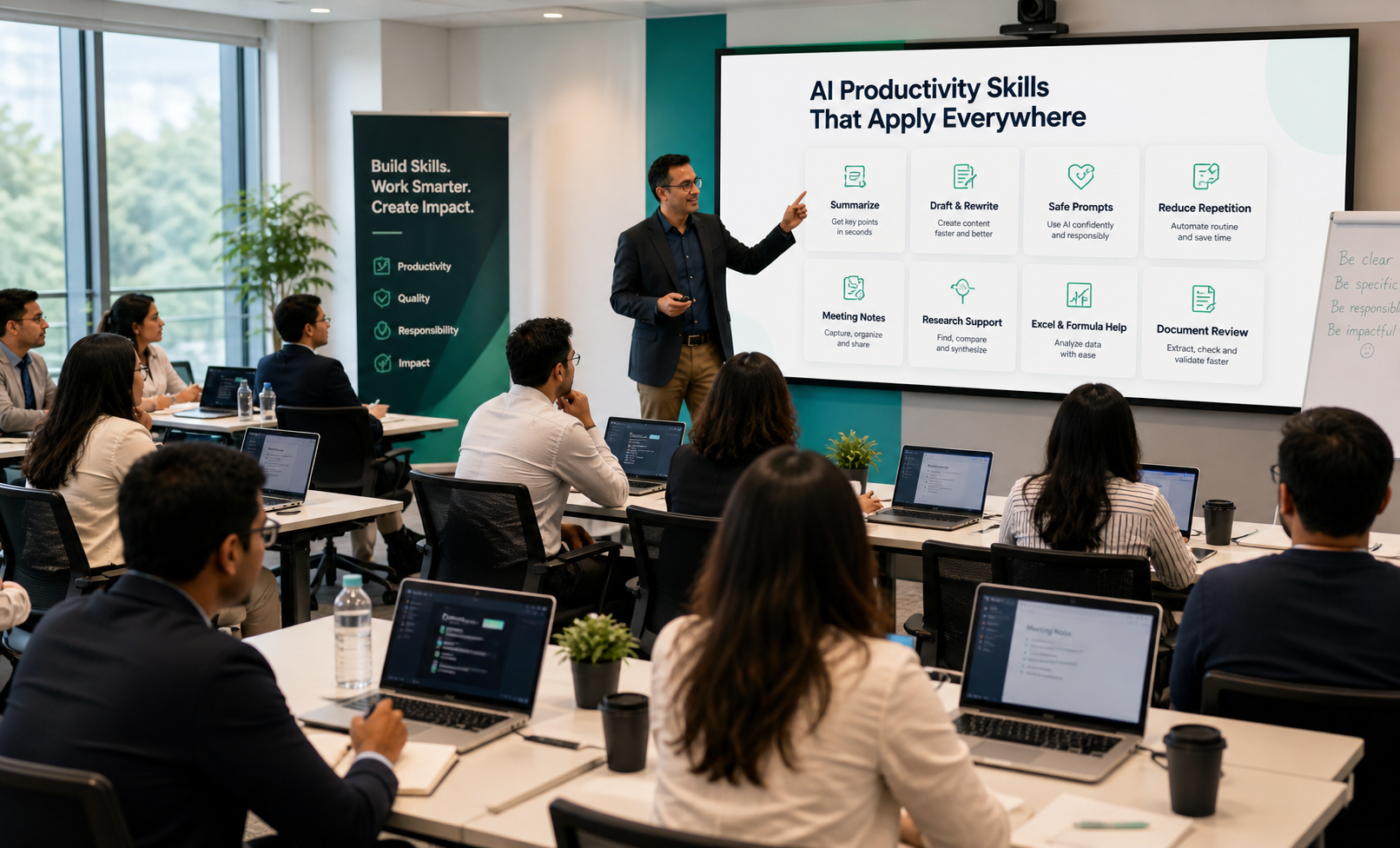
Why this works
Outcome-first beats tools-first training.
The workshop starts with organizational outcomes, then connects them to employee motivation and practical AI usage.
Typical AI training
- ×Tools first, outcomes later
- ×Generic training with no operational relevance
- ×No link to quality, rework or error reduction
- ×AI feels like extra workload
- ×No follow-up after the session
Alignment-first workshop
- ✓Start with productivity, quality and adoption goals
- ✓Employee motivation shapes the learning experience
- ✓Work performance connects to better speed, accuracy and quality
- ✓Organizational outcomes are linked to everyday AI use
- ✓Follow-up waves keep behavior change visible
Program scope
A full-year AI enablement roadmap, not a one-off workshop.
Designed as a full-year enablement program with phased training, workflow labs, adoption measurement, and leadership reporting. Pricing depends on cohort size, number of departments, trainer mix, rollout scope, and whether the client starts with a pilot workshop or moves directly into the annual roadmap.
Delivery faculty
Practitioner-led, governance-aware, UAE-context ready.
Faculty can be selected based on department needs, with a curated circle of AI safety, governance, legal, technology and transformation practitioners.
AI strategy
Enterprise adoption and transformation
Governance
GRC, policy and controls
Legal / Privacy
Data protection and AI risk
Safety
Responsible AI and ethics
Workflow AI
Skills, connectors and agent labs
FAQ
Questions L&D and leadership usually ask.
Clear answers to help the buyer understand scope, measurement, delivery, and how the foundation workshop connects to the annual program.
Is this a one-off workshop or a full-year program?
The foundation workshop can be delivered first as Phase 1, but the stronger recommendation is a full-year enablement roadmap with Phase 2 workflow labs and Phase 3 governance, champions, and leadership reporting.
What does L&D get from the first workshop?
L&D gets a structured learning journey, baseline adoption signals, employee confidence data, identified workflow opportunities, and a clear view of which departments are ready for deeper AI enablement.
How do you measure impact?
Impact is measured through live surveys, quizzes, confidence shifts, workflow redesign outputs, time-saving estimates, quality improvements, error-reduction opportunities, and follow-up adoption reporting.
Why include employee motivation?
Because adoption improves when employees understand how AI helps them personally and professionally. Reclaiming time and reducing pressure are the emotional drivers that make organizational adoption more likely.
Can the content be customized by department?
Yes. Phase 1 creates the baseline. Phase 2 can be customized by department, role, use case, risk level, approved tools, and internal governance requirements.
Which tools are covered?
The core module can cover ChatGPT, Claude, Gemini, Copilot, and selected specialist tools. Tool coverage should be adjusted based on the client’s approved ecosystem and internal policy.
How do you handle responsible AI and data sensitivity?
Responsible use is embedded into the exercises. Participants learn what must not enter AI tools, how to configure safer workflows, how to review AI outputs, and when human approval is required.
What is the best next step?
A 30-minute alignment meeting to confirm target cohorts, Phase 1 scope, approved tools, measurement priorities, and whether the client wants a pilot workshop or full-year rollout plan.
Ready when you are
Enterprise AI Enablement for Productivity, Quality, and Responsible Adoption. Measure the Shift.
Start with one foundation workshop, then expand into department workflow labs, adoption measurement, manager enablement, and leadership reporting across the year.
Equip one workforce cohort with practical, governed and measurable AI capability.
Start with a defined group, agreed outcomes and a practical delivery plan.
Review the agenda →