Who this is for
Teams researching topics and preparing written updates.
Start with the challenges your team faces and each person’s current skills.
A practical guide to learning Grok through bounded research and writing tasks, source verification and responsible handling of business information.
Teams researching topics and preparing written updates.
Start with the challenges your team faces and each person’s current skills.
A research brief with sources and open questions.
This is an example to help scope the learning; delivery arrangements are agreed before booking.
Define the decision the research should inform.
Separate verifiable information from generated assertions.
Record sources, uncertainty and the reviewer’s decision.
Use these stages to discuss the learning scope. Timing, tools and exercises depend on the team’s brief.
Define the decision the research should inform.
Separate verifiable information from generated assertions.
Record sources, uncertainty and the reviewer’s decision.
Bring a bounded research question and approved reference material. Confirm the available account features and information policy.
Estimate the time your team needs for sessions and follow-through. Change the example to fit your people; this is not a workshop package or quote.
Compare programs against your challenge, audience and available time. Confirm the actual schedule and fees with the organizer.
Find relevant programs in AISFYYou may need to sign in. Results stay on this page and are not saved or transferred to your AISFY account. Copy your plan before continuing.
Cohorts = participants ÷ cohort size, rounded up. Per-person time = session hours + weekly practice × weeks. Team time multiplies that by participants. Delivery hours count repeated sessions across cohorts; they exclude facilitator preparation.
Defaults are illustrative inputs, not benchmarks or recommended commitments. Changing or leaving the page resets the plan.
Open a topic for the full guidance, examples and references.
The Tow Center tested eight AI search systems with 200 news-identification queries each in March 2025. More than 60% of answers across the systems were incorrect. Tow Center — AI search citation experiment, March 2025.
Evidence limits: This tested particular versions on a specific news-identification task. It is not a current error rate for every answer or every business workflow.
Current-information exercises should reward finding the original publication rather than repeating a plausible summary. Ask participants to distinguish a source that exists from a source that actually supports the claim. A working link can still point to the wrong edition, geography or date.
Use three public news claims: one supported by an original announcement, one that confuses a forecast with a result, and one with no accessible source. Participants record publication date, exact supporting passage and verdict. An unresolved claim stays unresolved; the final briefing must not turn absence of evidence into confirmation.
Sources checked 20 October 2026. External examples are not AISFY customer results. Practice scenarios are editorial examples.
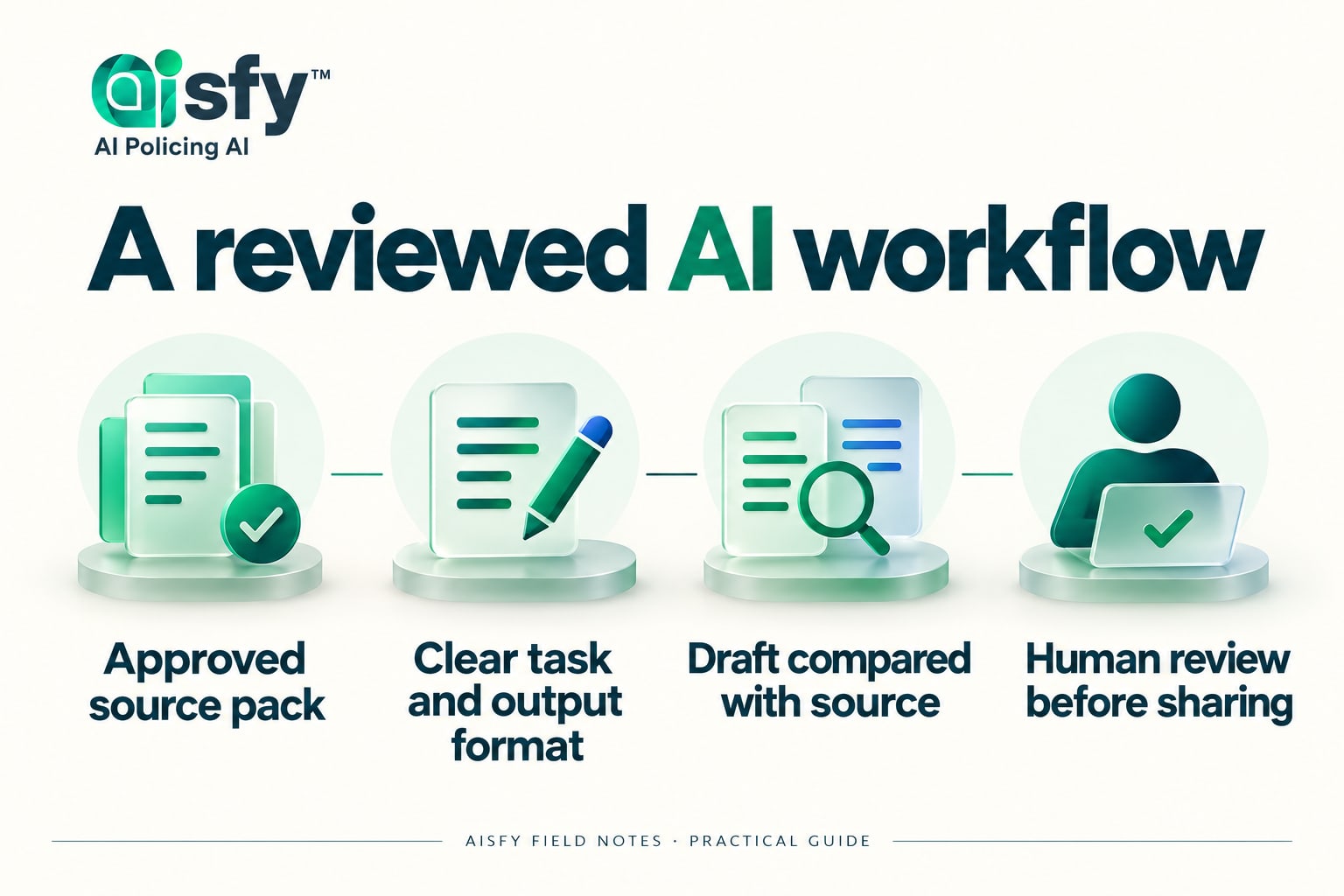
Train around a task your team can evaluate. Choose approved inputs, describe the intended output and decide who will check the result before using Grok for business work.
Use a fictional research brief or public source material. Ask for a structured summary that separates supported facts, interpretation and unanswered questions. Compare the output with the original sources rather than treating generated citations as proof.
Specify the purpose, audience, input documents, required format, quality criteria and boundaries. For example, a team can practise turning public product information into a comparison table while marking unknown details explicitly.
Open each cited source, verify the date and confirm that it supports the associated claim. Search access and available features can vary; check the current product documentation and your organization’s permitted account configuration before designing an exercise.
Confirm approved tools, account settings and data-handling rules before using internal information. Begin with public or fictional material when permission is unclear. Never assume a consumer account is approved for confidential work.
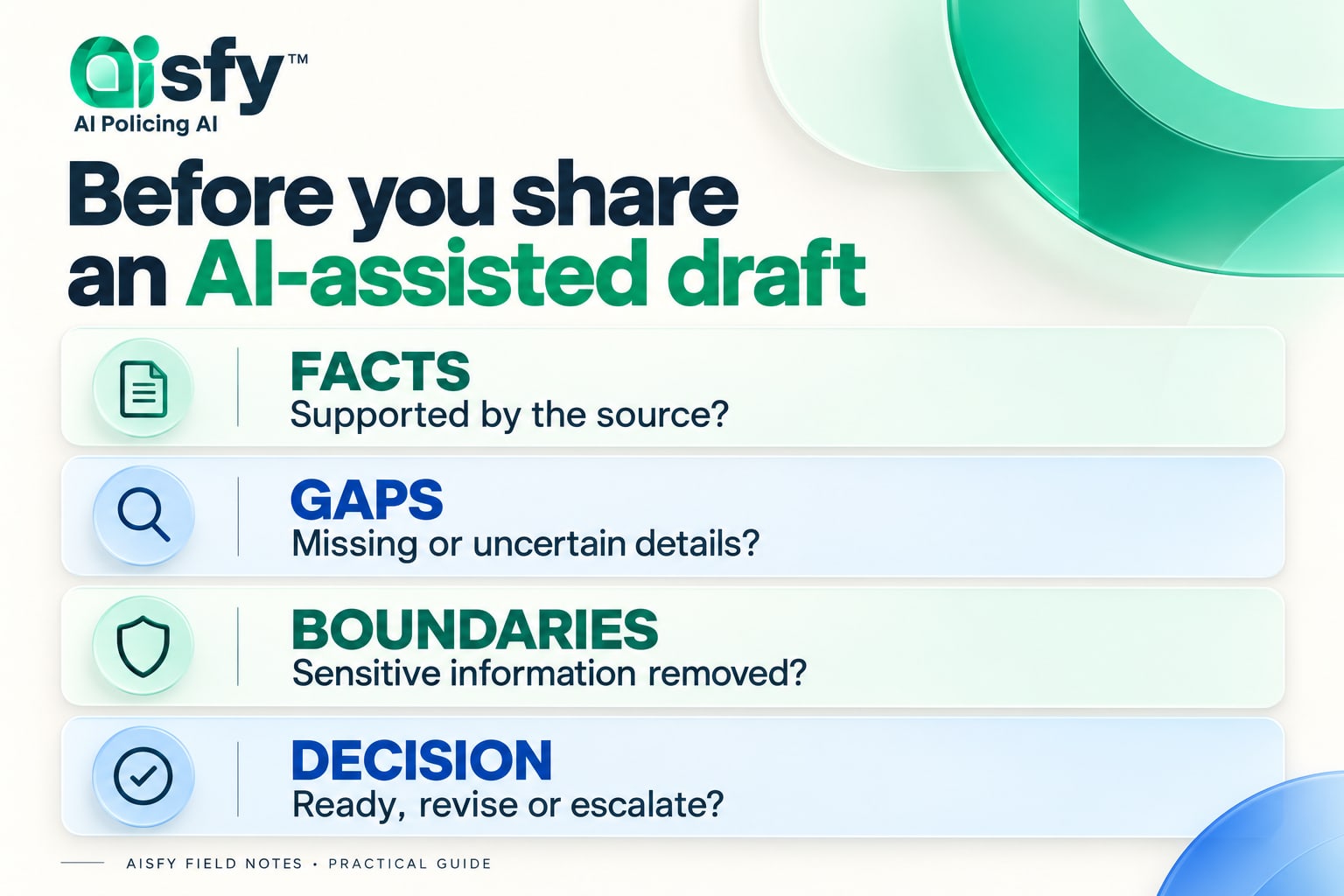
Ask participants to identify an unsupported statement, correct a draft and explain the review process. Capture a checked example and an owner for follow-through. A completed exercise does not establish business-wide performance improvements.
Start with a specific decision, such as whether an operations team should investigate a newly announced product. Define the relevant geography, time window and decision deadline. Collect the original announcement, product documentation and a separate source where available; a discussion about an announcement is not the announcement itself.
Build an evidence table containing the claim, source URL, publication date, exact supporting passage and unanswered question. Ask for a short brief separating confirmed changes, interpretations and implications for the team. Check each statement against the sources before sharing it.
A popular post can suggest a question worth investigating, but it cannot establish representative customer demand, employee opinion or product reliability. Note who produced a source, whether it is promotional, and whether several reports repeat the same original claim.
For practice, compare an official product announcement with two reactions to it. Ask participants to identify what each source can support. Preserve the difference between a reported capability, someone’s experience and a prediction. If the date or original source cannot be established, leave that point unresolved.
Save the decision question, scope, source list, checked findings and remaining uncertainty. Include a review date for time-sensitive facts. A colleague should be able to understand the conclusion without seeing the entire conversation.
Assess the handover by asking another participant to verify a claim and identify a reason the recommendation might change. This makes source checking and judgment visible, rather than rewarding the length or confidence of the generated answer.

Choose tools according to the task, organizational policy and review requirements. This guide does not assume one tool suits every workflow.
Share the challenge, audience and skills you want to develop. AISFY helps you plan the learning and connect with relevant expertise.
Scope, facilitator, availability and fees are confirmed before booking.
Explore AI workshops ↗