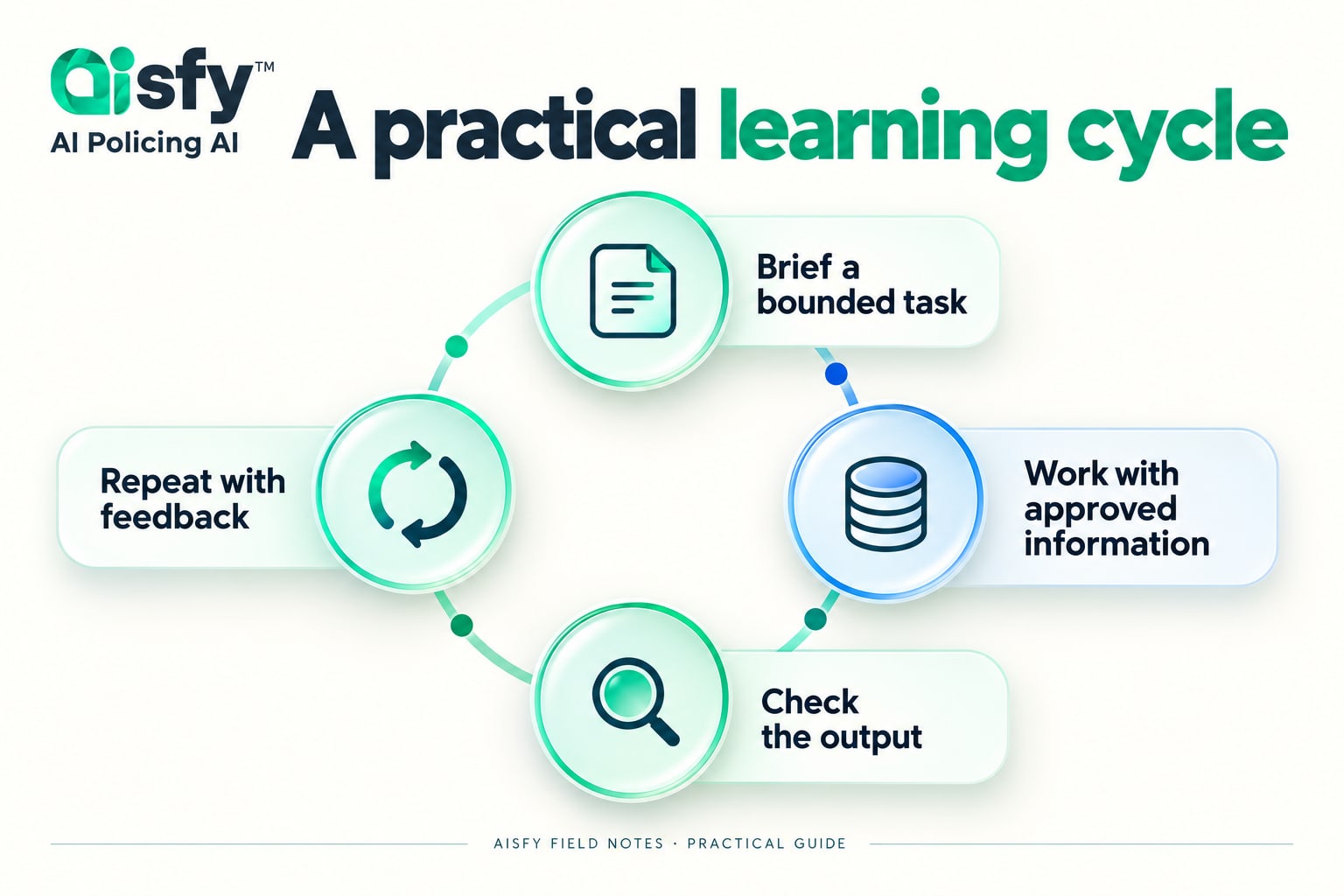
A manager can support AI learning by giving employees a suitable task, time to review it and permission to stop when the result is uncertain. The goal is to make careful practice possible, not to mandate tool usage.
How should teams choose an appropriate first workplace task?
Select a recurring internal task where errors can be detected before anyone acts on the output. A draft meeting summary may be suitable; a decision about a person’s eligibility or a safety-critical action needs different controls and is not a beginner practice task.
Ask the employee to describe the current method first. If there is no stable source or accepted quality standard, agree those before introducing AI. Otherwise, the manager will not know whether the new approach improved the work or merely changed its appearance.
How should teams make the review agreement explicit?
A practice plan should answer who checks the work, when review happens and what cannot happen before approval. Use existing organizational rules rather than creating an informal exception for a training exercise.
| Plan field | Illustrative entry |
|---|---|
| Task | Draft an internal weekly update |
| Inputs | Approved project notes with sensitive details removed |
| Reviewer | Named project owner |
| Quality criteria | Dates, owners and status match the source |
| Release boundary | No distribution before review |
| Stop condition | Conflicting source information or unexplained claim |
How should teams keep a short correction log?
For each attempt, record the task, the problem found and the change made. Categories such as unsupported fact, missing context, wrong tone and incorrect status help identify repeat learning needs. Avoid storing personal or confidential content in an unapproved log.
Discuss patterns without turning the exercise into a league table of employees. The number of AI interactions does not show how useful the work was. A participant who rejects an unsuitable draft may be showing better judgment than someone who uses every answer.
How should teams separate coaching from performance claims?
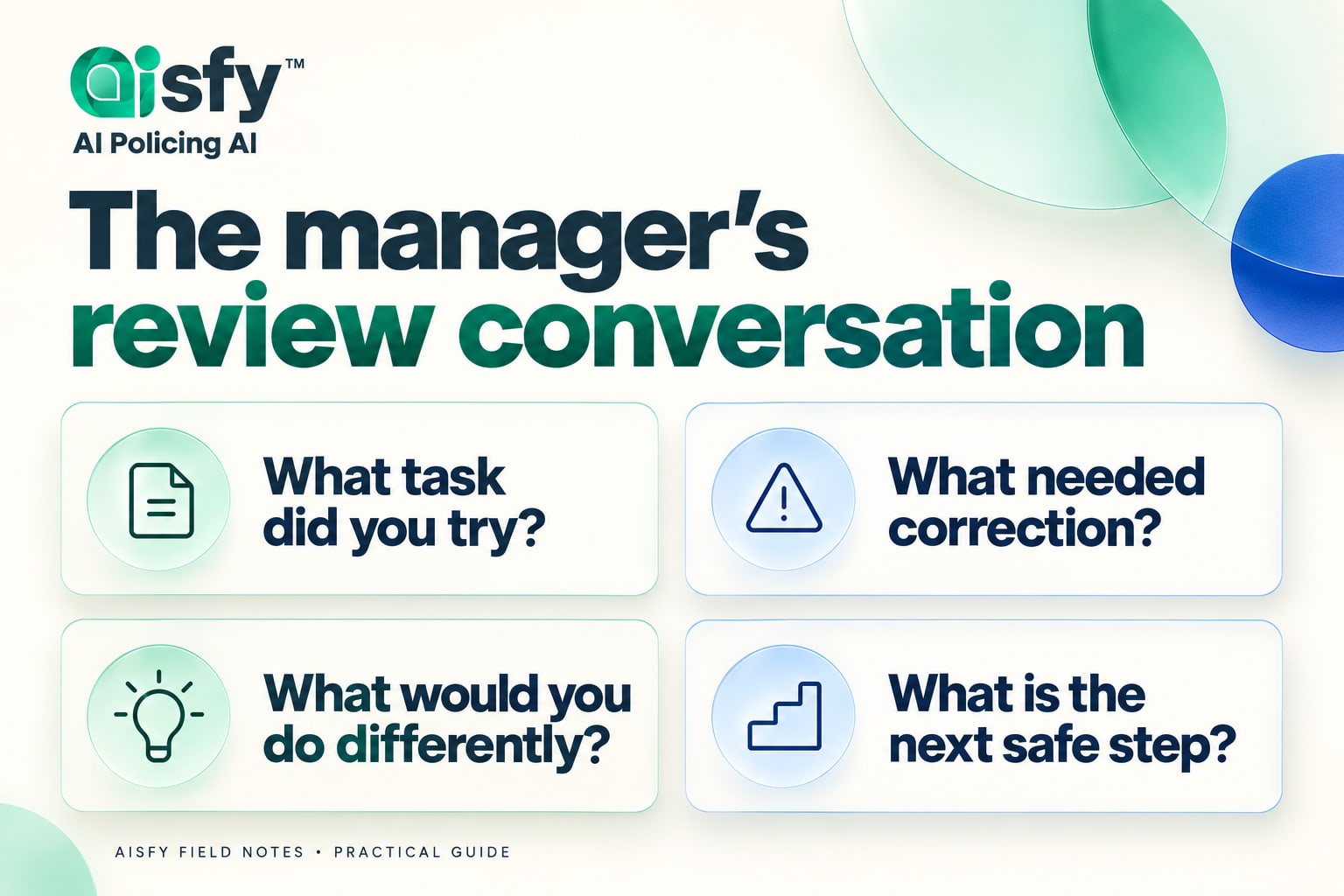
Review one example together and ask the employee to explain what they trusted and what they verified. This makes the reasoning visible and lets the manager identify whether the next need is better task definition, better source material or more review practice.
Keep confidence, task quality and elapsed time as separate observations. If review takes longer than before, investigate the cause. It may be a temporary learning cost or evidence that this task is a poor fit. Do not frame every result as a success.
How should teams decide whether to continue, adapt or stop?
Set a review point appropriate to the task frequency. Compare several suitable attempts, note exceptions and ask whether the process remains manageable for the reviewer. Continue only where the quality standard is met and the information rules are clear.
If the same error persists, reduce the task scope or return to a fictional exercise. If the main barrier is policy or account access, escalate it to the responsible owner. A follow-through plan is useful precisely because it can lead to a decision not to expand.
- Continue when evidence supports a bounded next step.
- Adapt when task design or review can be improved.
- Stop when the information or consequences exceed the approved scope.
- Keep the decision and remaining uncertainty visible.
What questions do readers frequently ask?
Should managers require employees to use AI every day?
Usage targets can encourage unsuitable use. Set a learning objective and quality standard instead, then assess whether the tool is appropriate for the task.
What should follow a beginner workshop?
A supervised, approved task with a reviewer and feedback is a practical next step. The timing and scope depend on the team’s work.
How can you put this guide into practice?
Use these questions to prepare a team brief, then explore ai training for non-technical employees to discuss the appropriate scope. Continue through the ai training for non-technical teams category for the related checklists and exercises.