How should writing research shape AI exercises for business teams?
A randomized experiment with 453 professionals found that ChatGPT reduced time on assigned writing tasks by 40% and increased assessed quality by 18%. Noy and Zhang — Science, 2023.
Evidence limits: These were selected writing tasks in an experiment, not a measurement of organization-wide savings or long-term learning.
Choose an output with an observable quality standard: a clear customer response, an accurate handover or an evidence-backed brief. Creativity and fluency are useful only after the essential facts and constraints survive the exercise.
How can a business-team exercise compare two approaches fairly?
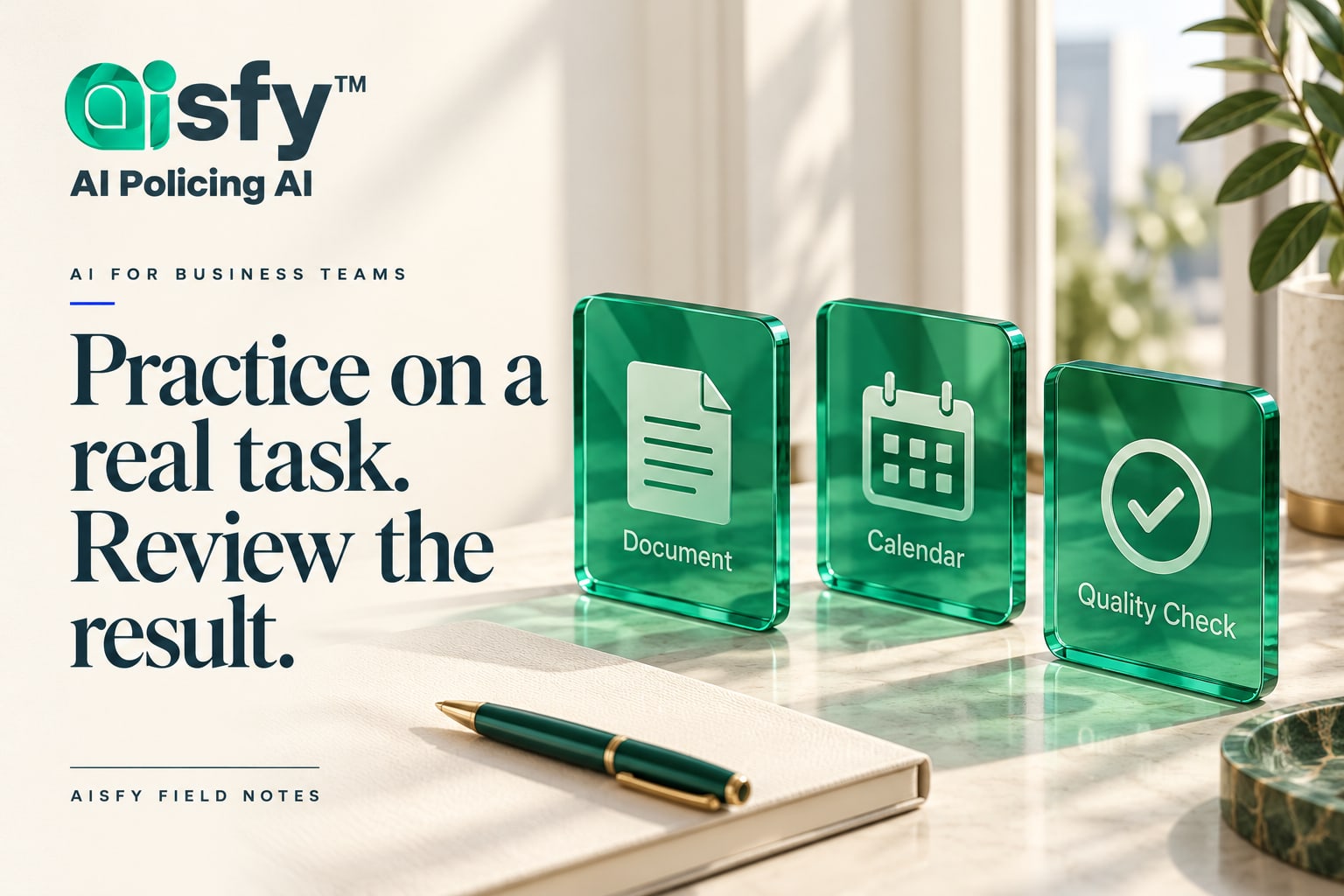
Give two groups the same fictional service notes and deadline. One drafts manually and the other uses an approved assistant. A reviewer who does not know which method produced each version checks facts and audience suitability. Discuss the errors and the review burden before comparing time; the exercise is a learning activity, not a statistically powered study.
Sources checked 20 October 2026. External examples are not AISFY customer results. Practice scenarios are editorial examples.
A good beginner exercise has an approved source, a clear output and a visible way to find mistakes. The three fictional exercises below build those habits without code, live customer records or automated decisions.
What review rubric should business AI exercises use?
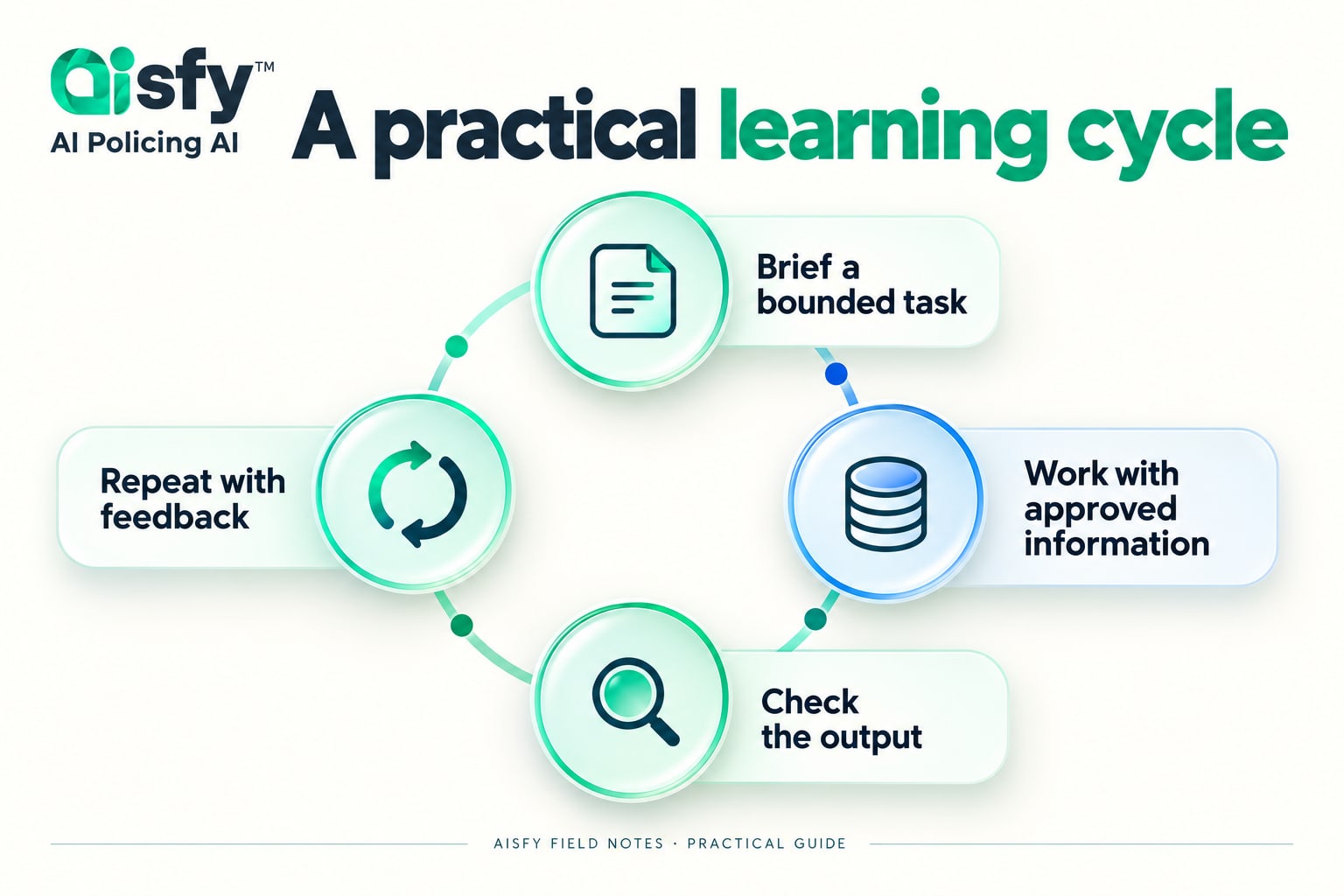
Give each participant a short source pack and ask them to define the reader, task, format and boundaries before using an approved AI tool. Pair participants so one creates the draft and the other checks it against the source. Swap roles for the next attempt.
The reviewer should be able to point to the evidence for each factual statement. A missing detail should remain a question, not become a plausible invention. Record what was corrected and why. That correction log is a more useful learning artifact than a screenshot of an impressive first answer.
How can a marketing AI exercise test factual accuracy?
Create a fictional product sheet with three verified features, a target audience and a list of claims that must not be made. Ask for a short campaign brief with one central message, two draft headlines and questions for the product owner. Keep the exercise internal.
Introduce a deliberate gap: the sheet contains no customer-results data. A successful draft avoids inventing a percentage improvement, testimonial or award. During review, participants distinguish a proposed message from an established fact and mark any claim that requires evidence.
- Source: fictional product sheet and audience description.
- Output: one-page internal campaign brief.
- Review: feature accuracy, unsupported claims and audience fit.
- Stop condition: no publication without normal approval.
How can an operations AI exercise improve a handover?
Provide fictional notes covering three open actions, one overdue item and a date that is uncertain. Ask for a handover table with owner, status and next question. Include a note that says an action is “expected to finish,” not completed.
Check whether the draft silently upgrades expectations into facts. Participants should preserve uncertainty and avoid assigning an owner who does not appear in the source. Discuss how a seemingly minor wording change could mislead the next shift.
| Source statement | Acceptable treatment |
|---|---|
| Completion expected Friday | Expected date, still unconfirmed |
| Owner not yet assigned | Owner: to be confirmed |
| Supplier has not replied | Awaiting response; no delivery promise |
How can a customer-service AI exercise test review skills?
Use a fictional enquiry and an approved policy extract. Ask participants to draft a response that explains the relevant process and identifies any question the policy does not answer. Do not send the draft or connect the exercise to a live inbox.
Have the reviewer check whether the response creates a refund promise, changes a deadline or invents an exception. Where the policy is silent, a good draft escalates the question to the appropriate owner rather than improvising a commercial commitment.
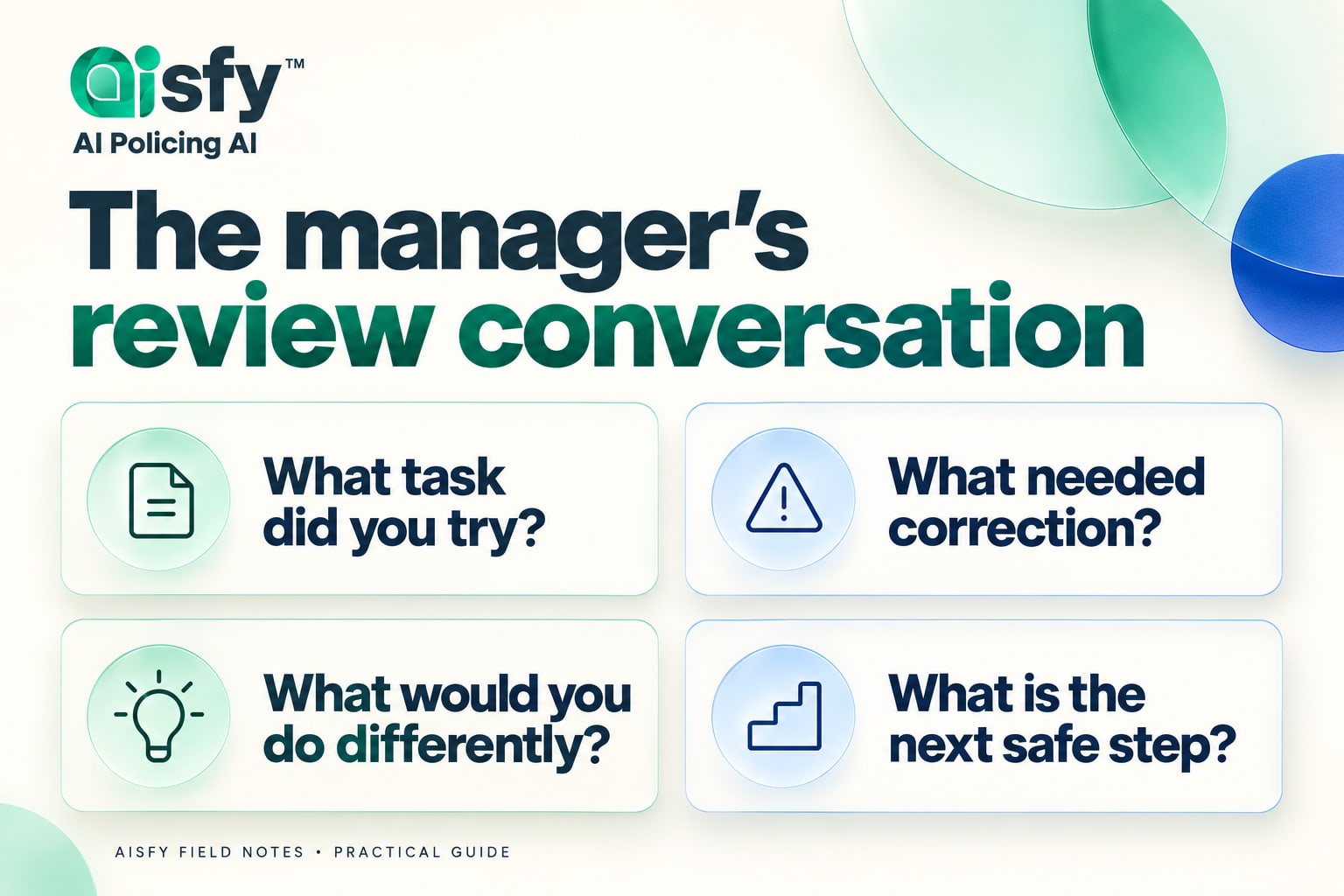
What should a business AI exercise debrief examine?
Ask which error was hardest to detect and what instruction helped make it visible. Compare the first and revised drafts using the same criteria. Time can be recorded for learning, but a single faster attempt does not establish a productivity gain.
Move to a supervised workplace trial only when the team has approved tools, appropriate information and a reviewer. The non-technical workshop page describes the learning scope; the manager practice guide in this category explains how to support the next step.
What questions do readers frequently ask?
Do participants need coding skills?
These exercises use document and communication tasks. The required skills are task definition, careful reading, source checking and responsible escalation.
Can we use real customer messages?
Only where your organization has specifically approved the information, tool and handling process. Fictional examples are sufficient for these learning exercises.
How can you put this guide into practice?
Use these questions to prepare a team brief, then explore ai training for non-technical employees to discuss the appropriate scope. Continue through the ai training for non-technical teams category for the related checklists and exercises.