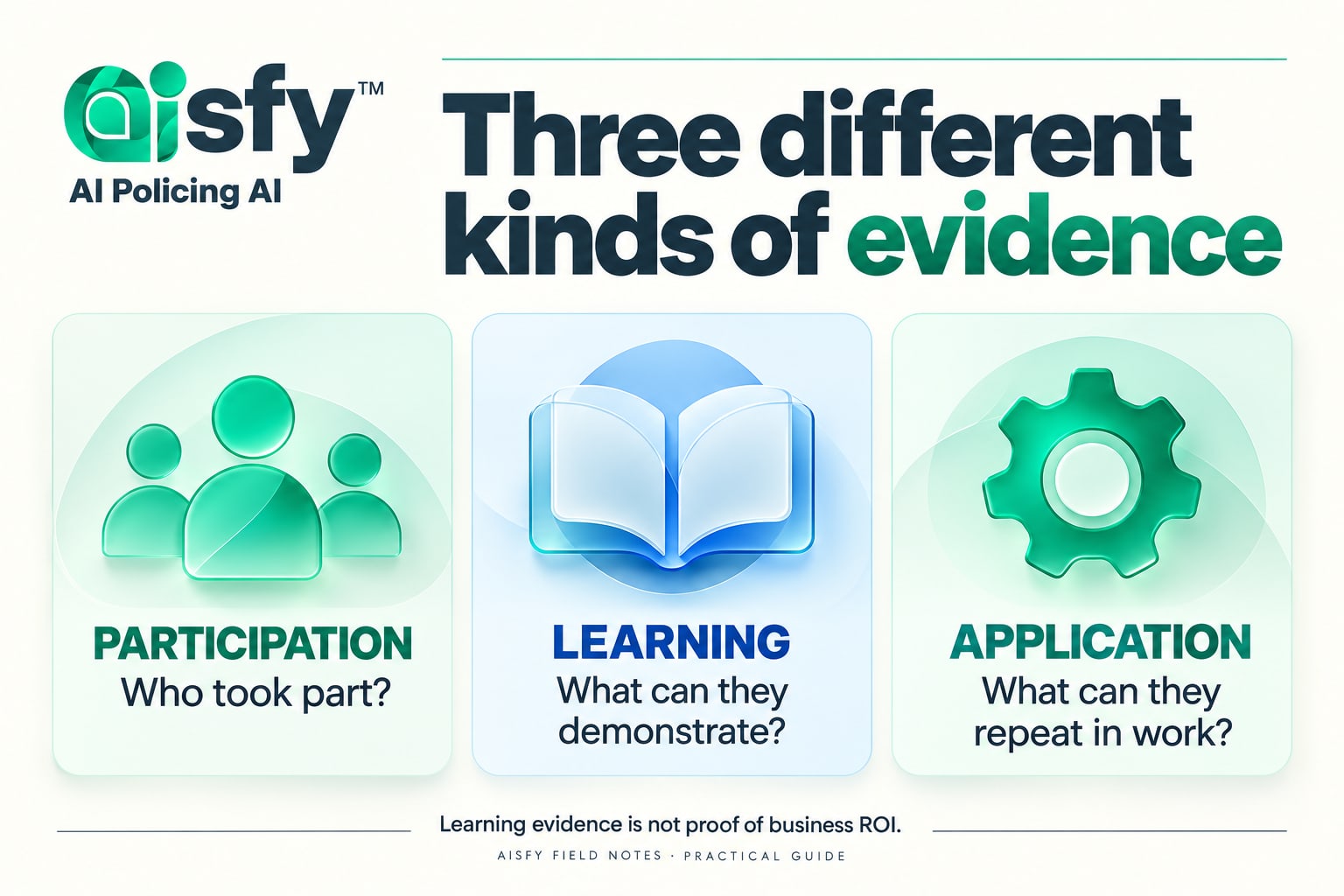
AI training evaluation should distinguish participation, demonstrated learning, supervised application and business results. Each requires different evidence; completing one level does not prove the next.
How should teams ask four different questions?
Attendance answers who took part. A task exercise answers what a participant can demonstrate under the exercise conditions. A supervised workplace example answers whether the skill was applied in a real task. Business outcomes require additional evidence about quality, effort or results over time.
A single completion score cannot reliably answer all four questions. Keep them separate in the report so managers can see where evidence exists and where further work is needed. This also makes it possible to identify a useful learning outcome without overstating its organizational effect.
How should teams design the evaluation before the session?
Choose the task and review criteria while planning the workshop. Participants should know what they are trying to learn, and reviewers should know what counts as acceptable work. Include at least one example containing an error or uncertainty that must be noticed.
| Question | Possible evidence | What it does not prove |
|---|---|---|
| Who participated? | Attendance record | Capability or adoption |
| What was learned? | Reviewed task and explanation | Consistent workplace use |
| Was it applied? | Approved workplace example | Business improvement |
| Did results improve? | Comparable baseline and follow-up | Causality without further analysis |
How should teams use a task rubric rather than a satisfaction score alone?
For a fictional document-summary workshop, assess whether the participant preserves the source meaning, identifies missing information and explains the review performed. Ask for a correction log, not only the final draft. Satisfaction feedback can still help improve delivery, but it answers a different question.
Keep critical failures visible. An output with an invented approval should not pass because it scored well on tone and formatting. Define the failure conditions in advance and explain them to participants so the assessment supports learning rather than surprise.
How should teams plan a supervised follow-up?
Ask the manager to identify a suitable task, approved information and reviewer. Record whether the employee had access and time to practise; lack of application may reflect a blocked workflow rather than lack of learning. Collect only evidence the organization permits.
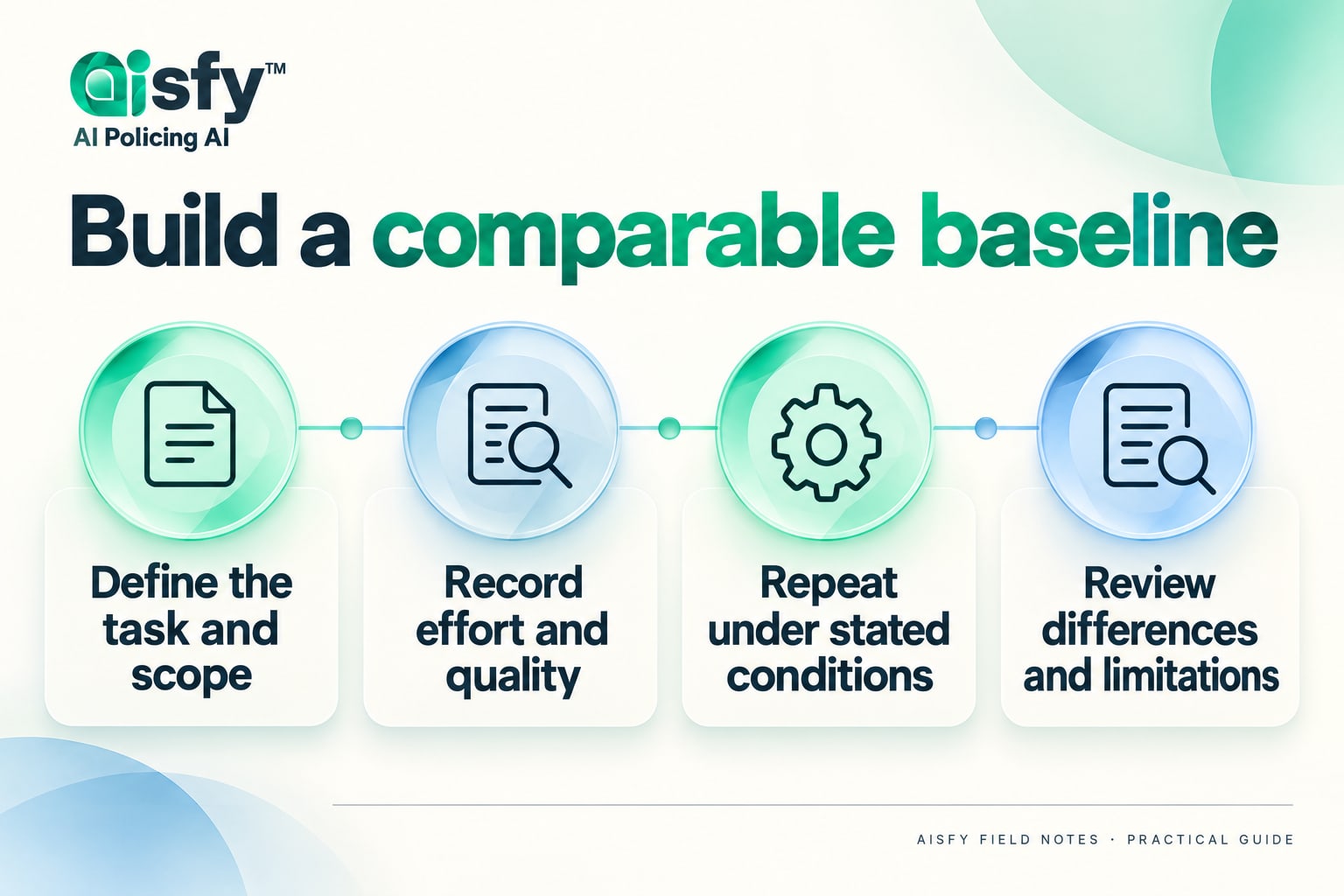
Choose the follow-up interval according to how often the task occurs. A monthly reporting task cannot meaningfully demonstrate daily adoption after a week. Compare suitable examples and document when the work changed enough to make the original baseline less useful.
How should teams report what the evidence supports?
A responsible report might say “participants identified the seeded errors during the exercise; workplace application has not yet been assessed.” If follow-up evidence exists, explain the sample, review method and limitations rather than implying organization-wide results.
Use the baseline guide in this category before making efficiency or impact claims. The point of evaluation is to make a better next decision: repeat the practice, change the task, resolve access barriers or expand a bounded trial. A report that identifies a missing prerequisite can be more useful than an unsupported success story.
- Participation and satisfaction recorded separately.
- Task performance assessed against a stable rubric.
- Application checked in an approved workplace context.
- Business results compared with a relevant baseline.
- Uncertainty and next actions made explicit.
What questions do readers frequently ask?
Should we measure at 30, 60 and 90 days?
Those intervals can be useful in some programs, but choose timing based on task frequency and the decision you need to make. A calendar alone does not make the evidence meaningful.
Can AISFY automatically attribute business outcomes to training?
The current product scope includes program operations, participation analytics, privacy-protected readiness aggregates and decision support. Complete business-outcome attribution should not be assumed.
How can you put this guide into practice?
Use these questions to prepare a team brief, then explore discuss organizational ai enablement to discuss the appropriate scope. Continue through the ai impact & measurement category for the related checklists and exercises.