
Why should an AI impact measurement baseline include unsuccessful attempts?
METR’s early-2025 experiment found experienced developers took 19% longer with AI. Its February 2026 update explained why later estimates were affected by selection bias. METR — February 2026 study update.
Evidence limits: The earlier result covered 16 developers and 246 tasks. Neither that result nor the biased follow-up establishes today’s effect for all developers or other occupations.
Excluding abandoned tasks makes the assisted method look better than the work actually experienced by employees. Record the full task set, including cases where staff returned to the manual method. Keep differences in difficulty and prior familiarity visible when interpreting the comparison.
How can a baseline avoid confusing faster drafting with better performance?
Illustrative example: manual drafting and review take 25 minutes. AI-assisted drafting takes eight minutes, but correction takes 20, giving 28 minutes overall. Record the three-minute increase alongside quality results. Repeat with comparable tasks before deciding whether the method, training or task selection needs to change.
Sources checked 20 October 2026. External examples are not AISFY customer results. Practice scenarios are editorial examples.
An AI impact baseline describes how a task performs before the change. Measure the whole task, including review and rework, and keep quality requirements constant when comparing methods.
What unit of work should an AI impact baseline measure?
Choose a specific output such as an approved internal report, not an abstract activity such as “using AI.” Record the task boundaries, source material, reviewer and acceptance criteria. If one method produces a rough draft while the other produces an approved report, the comparison is not equivalent.
For a fictional reporting team, the unit might be a reviewed weekly update with correct dates, complete actions and no unsupported claims. A report rejected by the reviewer is not a successful output simply because it was produced quickly.
Which fields make an AI impact baseline comparable?
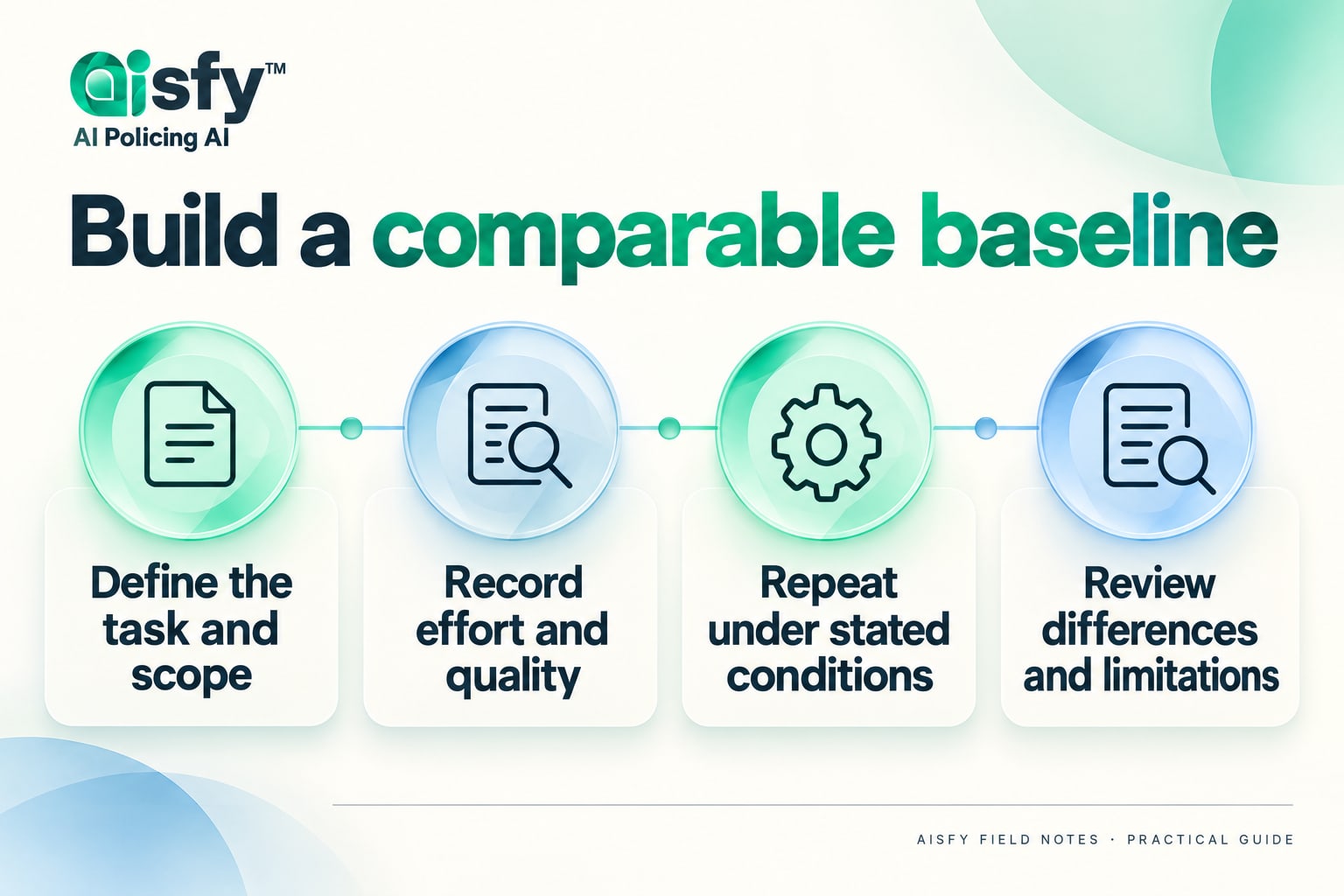
Observe comparable tasks using the current process. Capture the variation as well as the typical result, and document exclusions. A difficult report and a routine update should not be silently treated as equivalent examples.
The worksheet below is a suggested design, not a validated AISFY measurement product. Choose the evidence and privacy controls appropriate to your organization.
| Measure | Definition to agree |
|---|---|
| Accepted outputs | Outputs meeting the same review standard |
| Preparation effort | Time spent collecting and checking inputs |
| Drafting effort | Time to create the draft |
| Review and rework | Time to verify and correct the output |
| Quality failures | Missing, incorrect or unsupported material |
| Other costs | Relevant tool or process costs, if measurable |
| Context | Complexity, experience and unusual conditions |
How should AI impact measurement include review effort?
Use total task effort = preparation + drafting + review + rework. In a purely hypothetical example, a baseline report takes 20 minutes to prepare, 30 to draft and 10 to review: 60 minutes total. An AI-assisted attempt takes 20, 10 and 25 minutes respectively: 55 minutes total, assuming no additional rework.
The apparent drafting saving is 20 minutes, but the end-to-end difference is five. That is about 8.3% of the baseline, not a 67% overall saving. These invented numbers illustrate the calculation and are not an AISFY customer result. The comparison is useful only if both outputs meet the same quality standard.
What uncertainty should an AI impact baseline record?
A small trial may be influenced by task difficulty, novelty, participant experience or changes to the source documents. Record these factors instead of attributing every difference to AI. Where practical, compare similar tasks and maintain the same review rubric.
Do not turn a time estimate into revenue or ROI without a defensible conversion and relevant costs. Freed time may be redeployed, remain unused or create a different bottleneck. Explain which outcome was observed and which remains an assumption.
Which decision should follow an AI impact comparison?
Agree in advance what evidence would justify continuing, adapting or stopping the trial. A modest time improvement with worse quality may be unacceptable. A slower first attempt with better error detection may warrant further practice rather than a broad success claim.
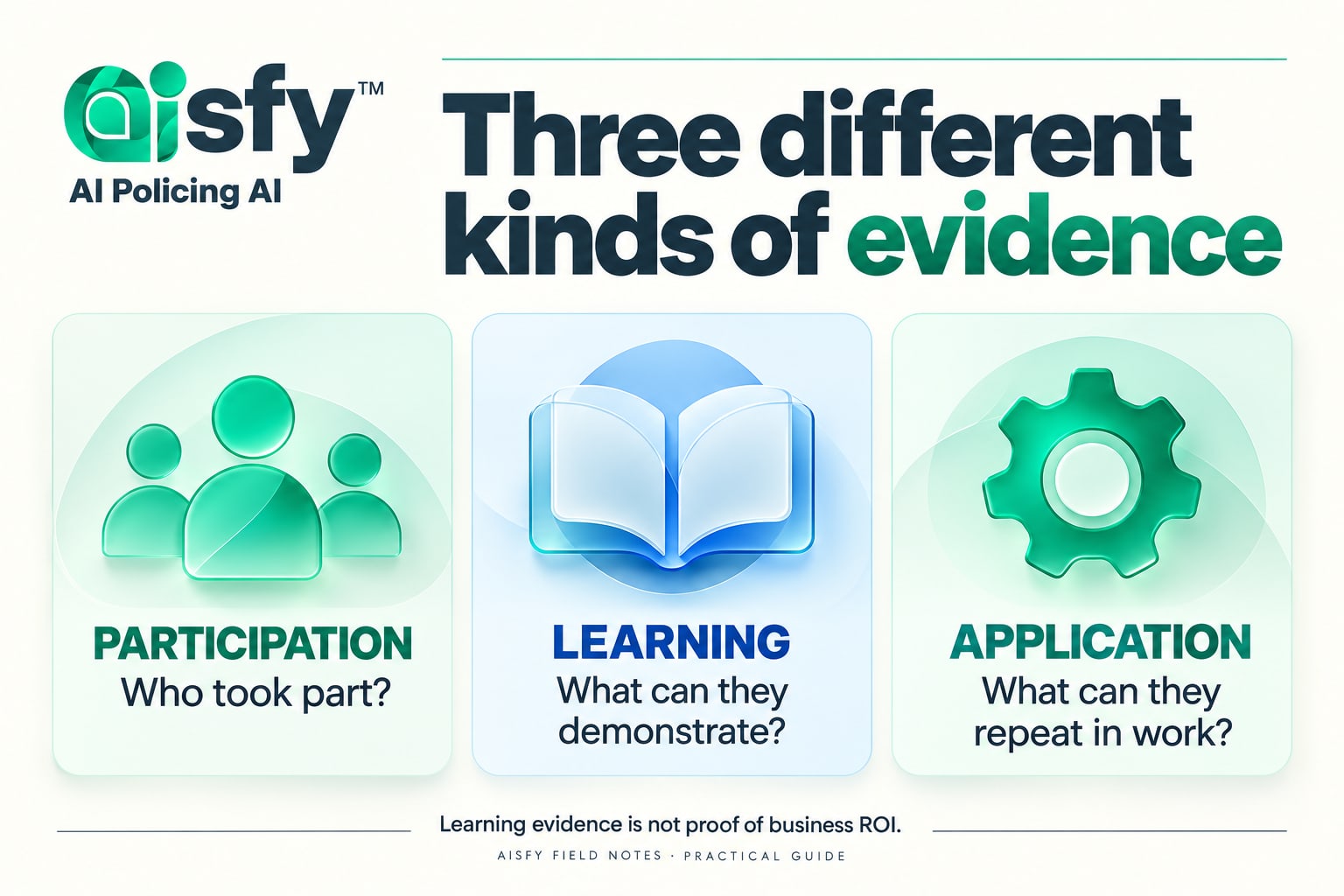
Use the training-evaluation guide in this category to separate learning evidence from workplace results. AISFY’s current enablement scope supports readiness, learning and decision support; this worksheet does not imply automatic business-outcome attribution.
- Compare the same accepted output.
- Include input preparation, review and rework.
- Document failed attempts and exceptions.
- Distinguish measured results from assumptions.
- Keep the next decision proportional to the evidence.
What questions do readers frequently ask?
Can interaction counts measure AI impact?
They can describe activity, but they do not establish output quality, efficiency or business outcomes. Use them only for the question they actually answer.
Does a faster draft prove ROI?
No. Review, rework, costs and the use of any freed capacity matter. ROI needs a defined method and defensible financial inputs.
How can you put this guide into practice?
Use these questions to prepare a team brief, then explore discuss organizational ai enablement to discuss the appropriate scope. Continue through the ai impact & measurement category for the related checklists and exercises.