Who this is for
Business teams.
Start with the challenges your team faces and each person’s current skills.
How to train non-technical teams to use ChatGPT, Copilot, Claude and Gemini safely and productively — without coding, and with adoption you can actually measure.
AI training for non-technical teams: Choose role-specific exercises for employees working with documents, customers and operations.
Business teams.
Start with the challenges your team faces and each person’s current skills.
A reviewed task example and a bounded workplace practice plan.
This is an example to help scope the learning; delivery arrangements are agreed before booking.
Specify the intended reader, source material and expected output.
Use approved information and make missing facts explicit.
Check each claim against the source and correct omissions.
Document the workflow, review owner and remaining limitations.
Use these stages to discuss the learning scope. Timing, tools and exercises depend on the team’s brief.
Specify the intended reader, source material and expected output.
Use approved information and make missing facts explicit.
Check each claim against the source and correct omissions.
Document the workflow, review owner and remaining limitations.
Choose a recurring task and approved or fictional sample material. Confirm tool access and identify a reviewer.
Estimate the time your team needs for sessions and follow-through. Change the example to fit your people; this is not a workshop package or quote.
Compare programs against your challenge, audience and available time. Confirm the actual schedule and fees with the organizer.
Find relevant programs in AISFYYou may need to sign in. Results stay on this page and are not saved or transferred to your AISFY account. Copy your plan before continuing.
Cohorts = participants ÷ cohort size, rounded up. Per-person time = session hours + weekly practice × weeks. Team time multiplies that by participants. Delivery hours count repeated sessions across cohorts; they exclude facilitator preparation.
Defaults are illustrative inputs, not benchmarks or recommended commitments. Changing or leaving the page resets the plan.
Open a topic for the full guidance, examples and references.
A 2025 study of 5,172 customer-support agents found a 15% average increase in issues resolved per hour after an AI assistant was introduced. Generative AI at Work — QJE, 2025.
Evidence limits: This staggered rollout studied a particular support system; it does not establish the effect of a general training course.
Start with a familiar work product rather than a tour of model features. Different experience levels may require different coaching: an experienced employee can identify an implausible answer quickly, while a newcomer may need a checklist explaining what to inspect.
Use a fictional complaint with a known policy and an ambiguous detail. Ask participants to produce a response and highlight every sentence that relies on the policy. The assessor checks accuracy, missing information and escalation. Completion speed counts only after the response meets the agreed standard.
Sources checked 20 October 2026. External examples are not AISFY customer results. Practice scenarios are editorial examples.
Participants explain how they checked an output and identify a condition that requires stopping or escalating.
Begin with familiar work: a service response, a handover or a short report. Explain the task and review criteria in ordinary language, demonstrate the method, and give participants time to practise. Assess existing knowledge of the work separately from familiarity with an AI tool; either gap can affect the result.
The universal skills underneath these are the same eight: structuring AI tasks, summarizing long documents, drafting and rewriting, turning meeting notes into actions, getting spreadsheet help, reviewing written work, doing research support, and using AI without exposing sensitive data. Teams still need domain knowledge and task-specific review before applying these methods to higher-consequence work.
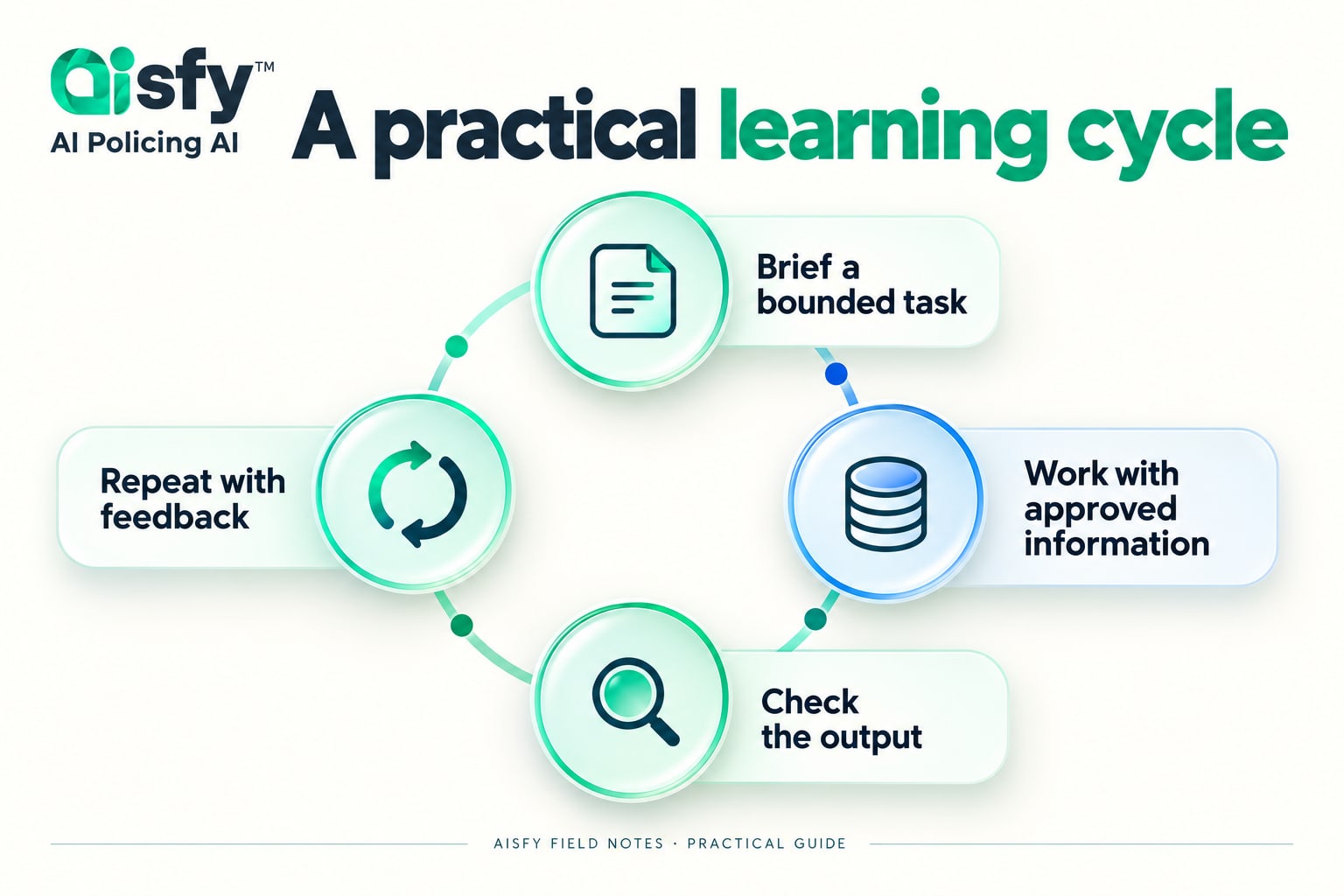
Use a short sequence that connects the task, guided practice and assessment. The following structure is an editorial planning suggestion; the appropriate depth depends on participants’ starting knowledge and the complexity of their work.
The fastest way to lose organizational trust in AI is a data incident caused by an untrained employee pasting something sensitive into a public tool. Non-technical training must make three habits automatic: know what never enters an AI tool (personal data, confidential terms, anything sovereign or client-owned), structure workflows so sensitive context is not needed, and review every output before it is shared — AI drafts, humans decide. These habits matter more for non-technical teams than for technical ones, because their work touches people data, financials and contracts daily.
A foundation session creates shared vocabulary and baseline skills. The compounding value comes afterwards, when individual departments redesign a real process with AI — a recruitment pipeline step, a monthly close narrative, a contract intake triage — and measure the before-and-after honestly. One improved workflow per team, properly measured, beats a hundred disconnected AI interactions nobody reuses.
Choose a familiar activity such as drafting an internal instruction from approved source material. Give participants a clear output format and ask them to mark every statement they cannot verify. This combines practical use with judgment, without requiring code or introducing advanced features before they are needed.
For a mixed cohort, offer role-specific variations with the same review rubric. Marketing may check product claims; finance may check figures; HR may check whether a draft invents policy. The common skill is matching an output to its source and knowing when to ask for help.
Agree a suitable practice task and a reviewer before the workshop ends. If staff lack approved access, resolve that dependency rather than asking them to use a personal account. Confidence should be interpreted alongside observed work, because people may become more confident without becoming more accurate.
Use a new task to check transfer, and include preparation, checking and correction when discussing efficiency. Keep early capability evidence separate from claims about wider adoption or business outcomes.
For workshop options, explore enterprise AI workshops. Use the preparation checklist and evaluation guide to connect the session to a practical next step.
These are illustrative learning activities. The final agenda, tool access, delivery format and fees are agreed during scoping.
Use fictional or approved sample documents. Participants check facts, omissions and unsupported conclusions before sharing a draft. A fluent answer is not evidence of accuracy.
No coding background is required for these task-design exercises. Tool access and organizational approval are separate prerequisites for hands-on practice.
Compare an initial task attempt with a reviewed example. Record corrections, remaining gaps and the conditions for a supervised workplace trial. Training attendance alone does not establish productivity gains.
Marketing, operations and customer-service teams can practise with fictional campaign briefs, handovers and enquiry drafts. Participants learn to define the task, check source evidence and identify when a result needs correction or escalation.
Discuss the roles in your group before booking. The session scope, tool access and exercises are agreed around the team’s needs; no coding background is required for the indicative document and communication activities.
Use fictional or approved material and assess a finished work product. The examples below are exercise options to discuss, not a fixed list of included deliverables.
| Team | Practice task | What the participant must check |
|---|---|---|
| HR and L&D | Turn an approved role brief into an onboarding checklist | Required steps, inclusive wording and named owners |
| Marketing | Develop message variants from a product fact sheet | No invented features, testimonials or performance claims |
| Finance operations | Draft a narrative from a small variance table | Arithmetic, period labels and unsupported causal explanations |
| Procurement | Compare fictional proposals against agreed criteria | Missing information, exclusions and consistent scoring |
| Legal operations | Compare two policy versions for review | Exact changed clauses and issues for qualified legal review |
| Service teams | Rewrite a service update for a customer | Facts, commitments, tone and escalation route |
Begin with a familiar task and a short source pack. Ask the participant to complete a first attempt, review an assisted version and explain which changes they accepted. Include an incomplete input so they practise asking for clarification rather than filling a gap with a plausible answer.
Use a second example with different details to test whether the method transfers. A person who can explain an error and correct it has demonstrated more than someone who can repeat the facilitator’s instructions. Offer support for language and digital confidence without treating employees with different starting points as a single group.
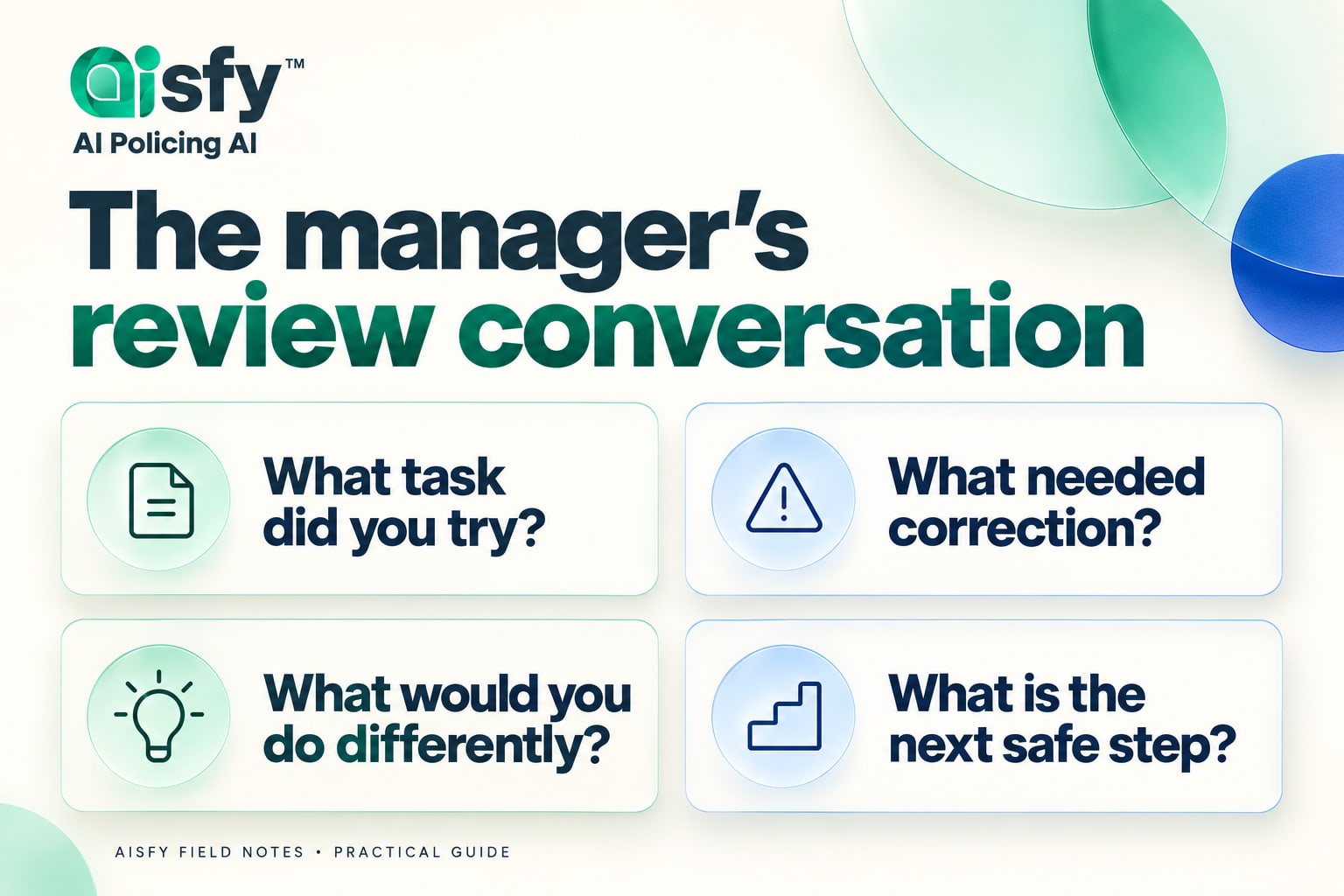
Choose one manageable task, make time for review and identify a person who can judge the output. Record the accepted result, corrections and unanswered questions. Discuss where assistance helped and where it added work.
Do not make employees prove a predetermined saving. Repeated rework may indicate unsuitable inputs, an unclear process or a task that should remain manual. Use the evidence to adjust learning and working conditions before widening use.
Bring a recurring task, approved sample material and the person responsible for reviewing the result.
The indicative scope is learning and task practice. Any integration or implementation would require a separately agreed scope.
A foundation exercise can be planned for people with little AI experience. Check participants’ digital skills, language and accessibility needs before selecting the task. Use familiar work and clear instructions, then assess their ability to check the result rather than assume a uniform starting point.
Choose an approved tool that supports the task and is accessible to the cohort. Consider licences, information rules, available features and the effort required to review the output. Existing software can inform the choice, but it does not establish that one product is best for every role.
Assess an unfamiliar task against agreed criteria for accuracy, completeness and appropriate review. Record corrections and the participant’s explanation of their decisions. Use confidence and attendance as separate signals, and evaluate later workplace use without presuming a fixed saving.
Share the challenge, audience and skills you want to develop. AISFY helps you plan the learning and connect with relevant expertise.
Scope, facilitator, availability and fees are confirmed before booking.
Explore AI workshops ↗