Research context · World Economic Forum · 2025
Employers surveyed for the World Economic Forum’s 2025 report expected 39% of workers’ core skills to change by 2030. Read the source ↗
This is an employer expectation for 2025–2030, not a measured loss of individual skills or an AISFY result.
Source checked 20 October 2026. External research and case examples are not AISFY customer results.Keep a small, connected record of the learning source, the idea you want to retain and the work task it could help with. Review it when you apply the idea, rather than collecting another folder of slides that you never open.
Why does learning need to continue after an event?
A workshop gives people time to explore a topic together. The conditions change when they return to work: the available data may be different, a manager may need to approve the task, and the example from the session may not fit the next customer or project. That is where a useful learning record becomes valuable.
The aim is not to capture every slide. Keep the ideas you can explain, the questions you still have and the original source. Treat the first attempt at applying an idea as another learning opportunity. The steps below are an editorial practice method, not a tested claim that keeping notes produces a particular performance gain.
What should you capture from each learning source?
Use the same small set of fields whether the experience was an internal workshop, an external course, a conference session or a conversation with an expert. This makes later review easier without pretending that every source has the same authority.
| Field | Useful entry |
|---|---|
| Source | Program or course title, session, speaker and date |
| Takeaway | One idea in your own words, with a source reference |
| Possible application | A specific task where the idea might help |
| Review need | What you must check or get approved before trying it |
| Open question | What you still need to understand |
How can you turn a takeaway into a practical next step?
Consider a fictional operations manager who attends a session about summarizing meeting notes. A weak takeaway is “AI can save time.” A useful one is “A draft summary needs each decision and owner checked against the original notes; unresolved items must stay unresolved.”
The next step could be to practise on a fictional meeting record, compare the draft with the source and record the corrections. Sending a real operational update is a separate decision that follows the organization’s information and approval rules. A saved takeaway is a starting point for practice, not permission to use a tool with confidential data.
- Choose one bounded task rather than changing an entire process.
- Use approved tools and suitable practice material.
- Name who will review the result.
- Keep the corrections alongside the lesson you learned.
How can you connect learning from different platforms?
Keep enough information to find the original learning again. The same subject may appear in a webinar, a course and a community discussion. Link the sources to the challenge they helped you think through, and note where they disagree. Do not merge a speaker’s opinion with a research finding as if they were equivalent.
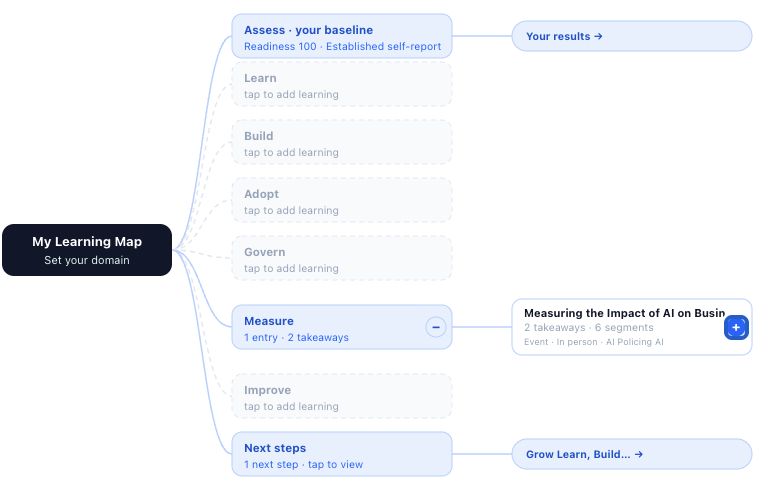
In AISFY, you can add learning sources to your Learning Map and connect sessions with takeaways. External learning is added by you; recording a course does not automatically import its content or certify that you completed it. Keep the original provider’s materials and access conditions in mind.
When should you revisit your notes?
Return to the record when the relevant task comes up, when a reviewer identifies an error or when the tool or policy changes. Ask what still applies and what needs checking. A short, purposeful review is more useful than rereading every note without a decision to make.
For a team, agree a review point after people have had a realistic opportunity to practise. Ask for the task, the source, the attempted result and the correction. If nobody had a suitable task or approved access, address that barrier before treating the lack of application as a training failure.
- Can I explain the idea without copying the slide?
- Where did the idea come from, and how strong is that source?
- What happened when I tried it on a suitable task?
- What should I repeat, change or learn next?
What should a continuing learning record help you decide?
A connected record should help you choose the next step: practise again, ask an expert, compare another source or find a program covering a missing skill. Avoid measuring progress only by the number of entries you have added. A smaller record of usable ideas can support a better decision than a large collection of unreviewed notes.
Keep learning activity, demonstrated skill and business outcomes distinct. A program entry shows where learning came from. A reviewed task shows what a person could do in that situation. A business result needs separate workplace evidence and a defensible comparison.
What questions do readers frequently ask?
Do I need to record every session?
Start with the sessions and ideas relevant to your current challenges. Preserve enough source information to revisit them later.
Does a Learning Map replace the original course?
No. Keep the original provider’s materials and access arrangements. Your map helps connect sources and takeaways; it does not transfer ownership or reproduce every course.
Can learning continue without another paid course?
Yes. Revisiting a useful session, practising a suitable task or discussing a question with a community can be a next step. Choose more training when it addresses a clear gap.
Which sources support this guide and further reading?
The exercises and worksheets are AISFY editorial guidance. They are not vendor certification or a claim of measured customer outcomes.
How can you put this guide into practice?
Use these questions to prepare a team brief, then explore enterprise ai training programs to discuss the appropriate scope. Continue through the enterprise ai training category for the related checklists and exercises.
How can you schedule practice after AI training?
Choose a few takeaways to revisit after a program, course or event. Work out a manageable practice window before recording your next steps in AISFY.
- Planned practice
- 3hours
- Practice window
- 3weeks
Add your learning source, sessions and takeaways in the Learning Map, then record how you could apply them.
Continue in your Learning MapYou may need to sign in. Results stay on this page and are not saved or transferred to your AISFY account. Copy your plan before continuing.
Assumptions & calculation
Planned practice = takeaways × minutes each. Weeks = total practice ÷ weekly availability, rounded up. This schedules time; it does not predict retention, proficiency or workplace results.
Defaults are illustrative inputs, not benchmarks or recommended commitments. Changing or leaving the page resets the plan.